
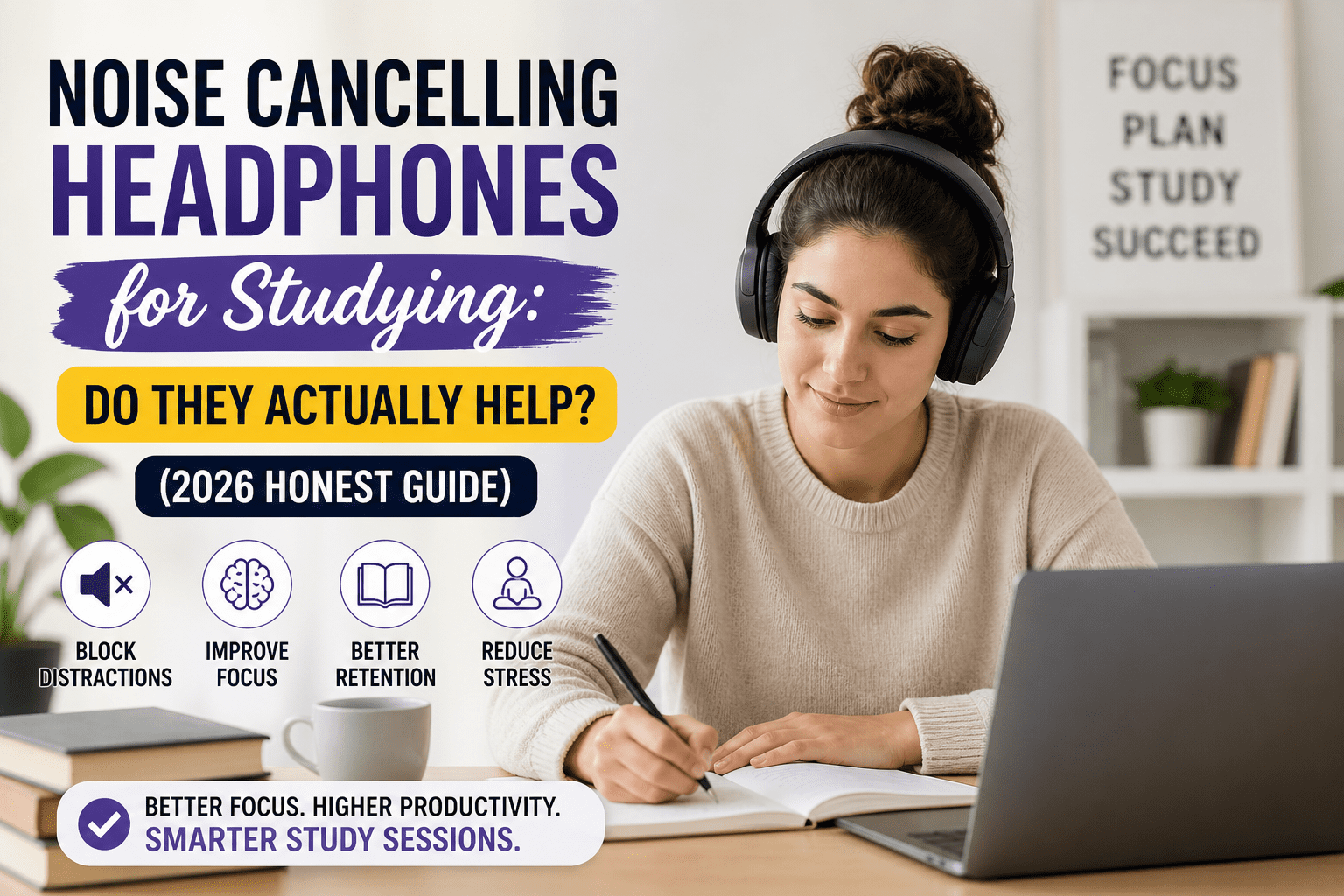
Noise Cancelling Headphones for Studying: Do They Actually Help? (2026 Honest Guide)
Noise cancelling headphones for studying have gone from a luxury purchase to something students and remote workers genuinely rely on — and for good reason.
If you’ve ever tried to study in a university library with someone tapping nearby, in a shared house with flatmates watching TV, or in a coffee shop with background espresso machine noise, you’ll know that environment has a direct impact on how well you can focus. The question isn’t really whether noise affects concentration — it does. The question is whether ANC headphones are the most effective tool for managing it.
In my experience, the answer is yes — but with important nuance. Not every noise cancelling headphone is designed for the kind of sustained, quiet study sessions that students and professionals need. And some people find that music through headphones creates its own form of distraction.
This noise cancelling headphones for studying guide covers the honest relationship between ANC headphones and study focus, what features genuinely matter for sustained concentration, and what to avoid when buying specifically for this use case.
According to research published on RTINGS.com, ANC headphones can reduce ambient noise by up to 35dB…
Do Noise Cancelling Headphones Actually Help You Study?
Noise Cancelling Headphones for Studying Help You Actually
Unpredictable background noise is one of the biggest enemies of focus. Overhearing fragments of other people’s conversations is especially damaging — it taxes your working memory and makes reading and writing significantly harder.
ANC headphones tackle this directly. A good pair can reduce ambient sound by 20–35dB. That’s enough to turn a busy library or café into something that actually feels quiet.
Three Ways to Use Noise cancelling headpones for Studying
1. ANC with no music Just pure noise blocking — no audio playing at all. Many students find this the most effective approach. It creates a sealed, quiet environment wherever you are. Think of it as a portable private study room.
2. ANC with instrumental music Lo-fi playlists, ambient music, or brown noise layered over ANC. This works well for tasks requiring long, sustained attention. The key is keeping it non-lyrical — lyrics compete with reading and writing.
3. ANC with podcasts or lectures Fine for passive listening and note-taking. However, avoid this for heavy reading tasks. Two simultaneous language streams fight for the same mental resources — and your reading always loses.
What Actually Works Best
For intense study sessions — deep reading, writing, problem-solving — ANC alone or ANC with non-lyrical music is the clear winner.
For lighter tasks — emails, admin, casual browsing — most audio works fine.
The bottom line: the right approach depends on what you’re studying. Start with silence. Add music only if silence feels uncomfortable.
What Type of Noise Do noise cancelling headphones for studying Actually Block?
What ANC Actually Cancels — And What It Doesn't
Before buying, it helps to understand what ANC is actually good at. It’s not magic. It works brilliantly in some situations and barely helps in others.
How Noise Cancelling Headphones Help Studying
ANC works best on steady, predictable, low-frequency sounds. These include:
- HVAC and air conditioning hum
- Traffic and road noise
- Train and bus engine rumble
- Refrigerator and appliance hum
- General library background noise
If these are your main distractions, ANC will make a real difference.
What noise cancelling headphones for studying Struggles With
ANC is much less effective on sudden or high-frequency sounds. These include:
- Someone talking nearby at normal volume
- Keyboard typing in a quiet room
- A door slamming suddenly
- A baby crying in a café
Don’t expect ANC to completely silence a person having a loud phone call next to you. It reduces the baseline noise — but won’t eliminate the specific distraction.
The Solution: ANC + Passive Isolation Together
This is where over-ear headphones have a big advantage. The large ear cups create a physical seal around your ears. This passive isolation handles the high-frequency sounds that ANC misses.
Together, ANC and good passive isolation cover almost everything. That’s why a quality pair of over-ear headphones beats earbuds for serious study use — every time.
Bottom line: If your study environment has steady background noise — cafés, libraries, offices — ANC is excellent. If the noise is unpredictable and sudden, passive isolation becomes just as important as ANC itself.
Noise cancelling headphones for studying or Passive Isolation — Which Works Better for Studying?
Both have a role, and the best study headphones combine both.
Active Noise Cancellation uses microphones to detect external sound and generates an inverse sound wave to counteract it. It’s most powerful against low-frequency continuous noise. It requires battery power to function and adds complexity to the headphone design.
Passive isolation is simply the physical blocking of sound by the headphone’s design — ear cups that seal around your ears create a physical barrier that attenuates sound, particularly high frequencies. It works even with the headphone powered off.
For studying, the combination works like this: Passive isolation handles the speech frequencies and sudden sounds that ANC struggles with. ANC handles the low-frequency constant hum that passive isolation alone doesn’t significantly reduce. Together, they create a genuinely quiet environment.
If you’re someone who studies in truly quiet environments — a home office, private library room, or quiet bedroom — passive isolation alone may be sufficient and a simpler, cheaper headphone works well. If you study in genuinely noisy shared spaces, active ANC earns its cost.
Should You Listen to Music While Studying? The Honest Answer
This is one of the most searched questions in the study productivity space, and the evidence gives a nuanced answer.
What the research consistently shows: music with lyrics impairs reading comprehension and writing quality for most people, particularly students. The language processing demand of lyrics directly competes with the language demands of reading and writing tasks.
What also holds up across studies: instrumental music at moderate tempo and consistent low-to-mid volume can maintain or slightly improve performance on repetitive, sustained-attention tasks like data entry, certain types of revision, and problem-solving in familiar domains.
The practical implication: if you’re reading dense material for the first time, writing an essay, or processing complex new information — silence or near-silence (ANC alone) is likely your best tool. If you’re revisiting familiar material, doing repetitive practice problems, or working on tasks that don’t require heavy language processing — instrumental music or lo-fi through ANC headphones is a legitimate and pleasant approach.
If you’re someone who studies with music out of habit rather than because it genuinely helps — it’s worth testing a week of studying in silence through ANC headphones to see whether your output quality changes. Many people are surprised by the result.
Noise cancelling headphones for studying Key Features That Actually Matter for Study
1. ANC Quality and Adjustability
For studying, the depth and consistency of noise cancellation matters more than any other single feature. You want ANC that genuinely quietens a noisy library, not ANC that simply reduces noise enough to tick a marketing checkbox.
The best implementations in 2026 for study use are Sony’s QN3 chip (WH-1000XM6) and Bose’s QuietComfort Ultra 2nd Gen — both of which handle the steady ambient noise of study environments effectively. ANC adjustability in the companion app is useful — being able to dial in the exact amount of noise reduction you want, rather than forcing a binary on/off, helps you find the right balance between isolation and awareness.
2. Comfort for Long Sessions
This is the specification most review sites mention briefly and most buyers underweight. Study sessions regularly run 2–4 hours. At that duration, a pair of headphones with aggressive clamping force, shallow ear cup depth, or rigid headband padding becomes actively uncomfortable — and discomfort kills concentration more effectively than ambient noise.
For study use, look specifically for:
— Memory foam ear cushions rather than basic foam
— Ear cup depth sufficient that your ear doesn’t touch the inner driver housing
— Headband padding that distributes pressure across a wide area
— Clamping force that’s secure but not tight
People who wear glasses should specifically check that headphone reviews address glasses compatibility — shallow ear cups that press glasses arms into the side of the head create significant discomfort during long sessions.
3. Battery Life for Full Study Days
A study headphone that dies mid-session is worse than no headphone at all — it breaks focus at the worst possible moment and leaves you without the acoustic environment you’ve built your session around.
For study use, aim for a minimum of 20 real hours with ANC active. Premium models like the Sony WH-1000XM6 deliver 30 hours. The Sennheiser Momentum 4 delivers 60 hours — effectively eliminating charging as a consideration for all but the most extreme study schedules.
Quick charge support is a practical backup: most premium models now offer meaningful playback from a 5–10 minute charge, which covers the “I forgot to charge overnight” scenario that every student will encounter.
4. Sound for Study — What Neutral Means in Practice
For studying without music, sound quality is irrelevant — you’re using the headphones as a noise blocker.
For studying with music, a sound signature that doesn’t fatigue your ears over 2–3 hours matters more than dramatic bass or exciting treble. Neutrally tuned or slightly warm headphones are easier to use as study companions than V-shaped, bass-heavy designs that demand attention.
The Sennheiser Momentum 4 and Bose QuietComfort Ultra both have sound signatures that many study-focused users describe as “easy to forget” — which is exactly what you want from a study headphone. You’re aware of music playing without it becoming a focal point.
5. Controls and Call Quality
For study use, you’ll regularly need to:
— Pause music to participate in class discussions
— Take calls between study sessions
— Quickly switch to transparency mode for brief interactions
A well-designed companion app, intuitive physical or touch controls, and a clear microphone for calls are practical study-session features that reviews focused on music performance often don’t prioritise.
The Sony Headphones Connect app is the most fully featured for managing these scenarios. Wear detection (auto-pause when you remove the headphones) is a small feature that becomes a daily convenience in a study context.
Study Environments and What Level of Noise cancelling headphones for studying You Need
University Library (Quiet Zone)
Ambient noise level is low — mostly HVAC, distant movement, occasional keyboard typing. For this environment, mid-range ANC is more than sufficient. The primary value is passive isolation and the signal to the people around you that you’re not available for conversation.
Even a budget ANC headphone like the Soundcore Life Q30 or JLab JBuds Lux ANC handles this environment effectively.
University Library (General Area), Coffee Shop
Moderate ambient noise — conversation, equipment sounds, general activity. This is where mid-to-premium ANC genuinely earns its place. The Sony WH-1000XM6 or Bose QuietComfort Ultra 2nd Gen reduce this environment to near-silence. Budget options reduce it to a more manageable level.
Shared Student House or Open-Plan Office
Unpredictable noise — people moving, conversations, doors, television. This is the hardest environment for ANC headphones because the sounds are varied and often speech-frequency. Premium ANC combined with good passive isolation handles this better than budget options, but no headphone fully eliminates unpredictable speech noise.
For this environment, ANC alone or with very low-volume ambient noise (brown noise, rain sounds) tends to work better than music.
Lecture Hall or Classroom
If you’re using headphones to listen to a recorded lecture or online content, standard playback quality is sufficient. If you’re using them between lectures in a student union or busy campus space, mid-range ANC handles this well.
What to Avoid When Buying Noise cancelling headphones for studying for Study Use
Heavy headphones: over 300g becomes genuinely uncomfortable during 3+ hour sessions. Weight you don’t notice during a 20-minute listening test compounds significantly over a long study block.
Touch-only controls: fine at a desk, annoying when you’re mid-sentence in a notebook and need to pause playback quickly with one hand. Physical controls or a simple tap-to-pause gesture are more practical for study use.
Poor transparency mode: you’ll use transparency mode more during study sessions than during any other use case — for brief conversations with tutors, answering questions in seminars, and responding to people around you. A transparency mode that sounds processed or robotic is a constant small friction during long study days.
Non-replaceable ear pads: for daily study use over 1–3 years, ear pads wear significantly. Headphones where pads can be replaced are a substantially better long-term investment than ones where pad degradation means replacing the entire headphone.
Noise cancelling headphones for studying - FAQs
Yes — for most people in most study environments. The primary benefit is reducing the unpredictable ambient noise that research consistently identifies as the biggest environmental obstacle to focused cognitive work. The degree of benefit depends on your environment: people studying in consistently noisy shared spaces see the most significant improvement. People in already quiet home offices see less difference.
For tasks requiring heavy language processing — reading dense material for the first time, writing essays, learning new concepts — silence or ANC alone typically produces better outcomes than music. For repetitive review, practice problems, or tasks with lower language demands — instrumental or non-lyrical music through ANC headphones is a legitimate approach that many people find sustainable.
Yes, and many people find this the most effective study approach. Running ANC without audio creates a quiet, sealed acoustic environment. Most premium ANC headphones allow this — some have a specific "ANC only" mode in the companion app, others simply let you enable ANC with no audio source connected.
For a full study day including commuting, library sessions, and evening study, you're looking at 6–10 hours of active use. Any headphone with 20+ real hours of ANC battery life covers a full study day without needing to charge. For daily use across a week without charging, the Sennheiser Momentum 4's 60-hour battery is genuinely practical.
It depends on how frequently you study in noisy environments. For someone who spends 4+ hours per day in shared study spaces, the productivity benefit of premium ANC justifies the investment over a 3-year degree. For occasional use in quiet environments, a budget option like the Soundcore Life Q30 or JLab JBuds Lux ANC delivers adequate performance at a fraction of the cost.
Ready to Choose Your Noise cancelling headphones for studying ?
Now that you understand what features genuinely matter for studying and how ANC headphones address different study environments, the next step is comparing the specific top-tested picks with honest pros, cons, and pricing.
➡️ See our top picks with full comparisons: [Best Noise Cancelling Headphones for Studying (2026) — Top Picks & Buying Guide]
And if you’re choosing between study headphones and a broader over-ear headphone for all-round use:
➡️ Full over-ear headphone guide: [The Complete Guide to Over-Ear Headphones (2026)]