
The Complete Guide to Best Hair Dryers: Types, Technologies & How to Choose the Best One (2026)
You have stood in a store — or scrolled endlessly online. Staring at twenty different hair dryers, each claiming to be professional-grade, ionic, ceramic, tourmaline, or all four at once. And yet, you still had no idea which one to actually buy.
Moreover you are not alone. In fact, most people find the hair dryer category overwhelming.
Further more the hair dryer market in 2026 is bigger and more competitive than ever. So, what used to be a simple appliance with two heat settings is now a category packed with high-speed motors, AI-driven heat sensors, and solid-state heating elements. Furthermore, prices now range from $15 to $700. Consequently, choosing the wrong one can mean frizzy hair, heat damage, or wasted money.
Therefore, this complete guide breaks down everything — the technologies, the terminology, the hair types, and the actual products worth your money in 2026. Furthermore, by the end you will know exactly which hair dryer is right for you.
What is a best Hair Dryer and How Does It Work?
At its core, a hair dryer is a compact electrical appliance that combines a motor-driven fan with a heating element. The fan pulls in cool air, the heating element warms it, and the nozzle directs that hot airflow across wet hair. As a result, heat accelerates water vapours from the hair. While the airflow simultaneously removes the loosened moisture.
However, the science behind modern 2026 hair dryers goes significantly deeper than this basic mechanism. Furthermore,
understanding exactly how each component works, helps you appreciate why two dryers with identical wattage can produce
completely different results on your hair.
Here is, what is actually happening inside a modern hair dryer:
- Ionic generators that emit negatively charged ions to break down water molecules faster
- Ceramic or solid-state heating elements that distribute heat evenly and emit far-infrared radiation
- High-speed digital motors that spin at up to 120,000 RPM, creating powerful airflow at lower temperatures
- AI heat sensors that monitor and adjust temperature thousands of times per second to prevent heat damage
However, understanding these mechanisms consequently explains, why a $400 dryer can genuinely behave differently from a $30 one. Moreover, it is not just marketing — the engineering differences are real and measurable. Furthermore, as engineers at Dyson have documented in their product development research, controlling heat at the source is fundamentally more effective than relying on user technique alone. Consequently, the technology inside the dryer matters far more than most buyers realise.
Types of Best Hair Dryers: Which One Suits You?
Not all hair dryers are built the same. Here are the six main types and who each one is best for.
1. Standard Corded Hair Dryers
The most common type available today. Furthermore, standard corded dryers are reliable, available in every price range. Consequently the best choice for daily home use. Additionally, they deliver consistent power every session.
✅ Best for: Most people doing everyday drying at home.
2. Professional Hair Dryers
Originally designed for salon use, professional hair dryers are now increasingly popular at home. Moreover, they feature 1875W+ motors, wider heat and speed ranges. Furthermore professional-grade durability. Therefore, top brands in 2026 — including BaBylissPRO, GHD, and T3 — are worth considering for heavy daily use.
✅ Best for: Frequent blow-dryers who want performance and longevity.
3. Travel Hair Dryers
Travel hair dryers are compact, foldable, and dual-voltage (100–240V). So, making them safe for international use. However, they typically run between 1000–1600W, That is why they trade some power for portability. Nevertheless, for frequent travelers they are an essential tool.
✅ Best for: Frequent travelers, gym bags, and small storage spaces. → Conair InfinitiPRO Review: Best Travel Hair Dryer of 2026?
4. Cordless Hair Dryers
Battery-powered and fully portable. The 2026 generation of cordless dryers has closed much of the performance gap with corded models thanks to improved battery tech.
✅ Best for: On-the-go styling, gym use, travel.
5. Hooded Hair Dryers
A salon staple — sits over the entire head for even, gentle drying. Ideal for deep conditioning treatments and natural hair care routines.
✅ Best for: Natural hair, deep conditioning, hands-free drying.
6. Hair Dryer Brushes (2-in-1 Stylers)
A hybrid that combines dryer airflow with a round brush barrel — dry and style in one pass. The Revlon One-Step remains the category leader even in 2026.
✅ Best for: Anyone wanting a blowout look without a separate round brush. → Revlon One-Step Volumizer Review: Best Budget Hair Dryer?
Best Hair Dryers Technologies Explained: Ionic, Ceramic, Tourmaline & More
This is where most buyers get confused. Here’s what each technology actually does — in plain language.
1. Ionic Technology
Ionic hair dryers emit negatively charged ions that neutralize positive ions in water molecules. Therefore, causing them to break apart faster. As a result quicker drying, less frizz, flatter cuticle = smoother, shinier hair.
⚠️ Catch: Too much ionic output can over-smooth fine or limp hair. Look for an ion on/off toggle.
✅ Best for: Thick, coarse, or frizzy hair.
2. Ceramic Technology
Ceramic elements heat evenly and, furthermore, emit gentle far-infrared heat that warms hair from the inside out rather than blasting the surface. As a result, there is less hot-spot damage and more consistent drying throughout the session. Catch: However, lower peak temperatures can mean slower drying for very thick hair. Therefore, pure ceramic dryers may not be ideal for very coarse or dense hair types.
 Best for: Damaged, color-treated, or fine hair.s
3. Tourmaline Technology
Tourmaline is a semi-precious gemstone. That when it is ground into powder and coated onto ceramic components, it amplifies ionic output significantly. Consequently, the result is essentially ceramic technology combined with enhanced ion emission. Moreover, this combination produces extra shine and superior frizz control compared to standard ceramic alone.
✅ Best for: Dry, coarse, or particularly frizzy hair types.
4. Infrared Technology
Far-infrared heat penetrates the hair shaft directly, rather than heating the outer cuticle first. As a result, the surface temperature stays lower while the drying power remains equivalent. Therefore, infrared technology causes less visible heat damage — a critical advantage for chemically processed hair.
✅ Best for: Heat-sensitive, bleached, or chemically processed hair.
5. High-Speed Digital Motors
High-speed digital motors were first popularized by Dyson and have consequently been adopted by Shark, T3, and other premium brands. Traditional AC motors, in contrast, spin at only ~20,000 RPM. However, high-speed digital motors hit 110,000–120,000 RPM — generating intense airflow at lower heat levels. As a result, drying is faster without the temperature spike that causes damage.
✅ Best for: Anyone wanting fast drying with minimal heat exposure.
Best Hair Dryers - Quick Technology Comparison
| Technology | Drying Speed | Frizz Control | Heat Protection | Best Hair Type |
|---|---|---|---|---|
| Ionic | Fast | Excellent | Good | Thick, frizzy |
| Tourmaline | Fast | Excellent | Good | Coarse, dry |
| Ceramic | Moderate | Good | Excellent | Fine, damaged |
| Infrared | Fast | Good | Excellent | Color-treated |
| High-Speed Motor | Very Fast | Good | Excellent | All types |
How to Choose the Best Hair Dryer for Your Hair Type
Your hair type is, without question, the single most important factor in choosing the right dryer. Furthermore, choosing incorrectly — for example using high heat on fine hair — can cause damage that takes months to repair. Therefore, identify your hair type first and let that guide every other decision.
Fine / Thin Hair
Fine hair reaches its thermal limit faster than other hair types. Moreover, too much heat causes the moisture inside the shaft to expand — a condition called “bubble hair” that consequently leads to breakage. Therefore, heat control is the most important feature for fine hair.
What to look for:
- Ceramic or ionic technology with adjustable ion output
- Multiple heat settings, including a low option below 300°F
- Lightweight design under 1.5 lbs
- A cool shot button for setting style without heat
Top picks: Dyson Supersonic, Bio Ionic Graphene MX → Dyson Supersonic Review: Is It Worth It in 2026?
Thick / Coarse Hair
Thick hair holds significantly more water than fine hair and consequently requires more energy to dry. Furthermore, you need strong airflow and sustained heat output throughout the session — a dryer that loses power mid-session will leave thick hair frizzy and half-dried.
What to look for:
- 1875W or higher motor
- Ionic or tourmaline technology for frizz control
- High speed setting with strong consistent airflow
- Concentrator nozzle for directional styling
Top picks: BaBylissPRO Nano Titanium, GHD Helios → BaBylissPRO Nano Titanium Review: Best Professional Hair Dryer?
Curly / Wavy Hair
Curly hair requires even heat distribution and, moreover, a diffuser attachment to enhance natural curl pattern without causing frizz. Furthermore, concentrated airflow from a standard nozzle will disrupt curl pattern and cause frizz regardless of technique. Therefore, a diffuser is non-negotiable for curly hair.
What to look for:
- Diffuser attachment included in the box
- Ionic technology for frizz control
- Low-to-medium heat settings
- Even airflow distribution across the diffuser surface
Top picks: Dyson Supersonic, Shark Speedstyle → Shark Speedstyle Review: The Best Dyson Alternative in 2026?
Treated / Damaged Hair
Chemically processed hair has a weakened cuticle structure and is consequently especially vulnerable to thermal stress. Furthermore, even moderate heat applied incorrectly can cause significant additional breakage on already-damaged hair. Therefore, heat protection and control are the absolute top priorities for this hair type.
What to look for:
- Ceramic or infrared technology
- Intelligent heat control or auto heat regulation
- Lower maximum temperature settings
- Always use a heat protectant spray alongside the dryer — without exception
Best Hair Dryers - Wattage & Heat Settings
What Wattage Actually Means - Need to Know
Wattage measures power consumption — not directly the heat output or drying speed. However, higher wattage generally means more powerful airflow, which consequently translates to faster drying. That said, modern high-speed digital motors can furthermore produce equivalent airflow at lower wattages than traditional models. Therefore, do not judge a dryer by wattage alone.
In North America, the electrical standard caps most home hair dryers at 1875W on a 120V circuit — which is why you will see that number listed across so many models. Furthermore, as outlined in the US Consumer Product Safety guidelines for personal care appliances, this is the practical ceiling for home use in the US, not an arbitrary spec. Therefore, do not be misled into thinking a 1875W dryer is somehow underpowered — it is the correct maximum for safe home use.
Best Hair Dryers - Wattage Guide by Use Case
Under 1000W
Designed exclusively for travel use. Furthermore, these compact and foldable dryers are portable but consequently not suitable for thick hair or long daily drying sessions.
1000–1400W
Ideal for fine hair and occasional use. Moreover, the lower power output is gentle enough for heat-sensitive strands — consequently resulting in minimal risk of damage.
1875W
The sweet spot for most US home users. Furthermore, 1875W covers the majority of hair types for everyday use. Additionally, it is the standard power rating for most quality home dryers on the market.
2000W+
Built for thick and coarse hair as well as professional salon environments. Furthermore, 2000W+ models deliver maximum power and consequently perform best in demanding or high-frequency use situations.
Best Hair Deryers - Heat Settings Explained
- 🌡 Low heat — Color-treated, fine, or damaged hair. Slow drying but minimal cuticle stress.
- 🌡🌡 Medium heat — Normal or wavy hair. The setting most people should use most of the time.
- 🌡🌡🌡 High heat — Thick or coarse hair only. Use sparingly and always with a heat protectant.
- ❄️ Cool shot — Locks the cuticle shut after styling to hold shape. Always finish with this.
Best Hair Dryers Key Features
Beyond the tech specs, here are the practical features that separate a great dryer from a frustrating one.
Attachments
At minimum: a concentrator nozzle for precision styling and a diffuser for curly hair. In 2026 the gold standard is magnetic attachments (Dyson, Shark) — swap without burning your fingers.
Weight & Balance
Look for under 1.5 lbs for comfortable daily use. Weight should be evenly distributed between handle and barrel — poor balance causes wrist fatigue fast.
Cord Length
Under 6 feet feels restrictive in most bathrooms. Professional models often have 9-foot cords. For travel dryers, look for a swivel cord base to prevent tangling.
Noise Level
Traditional AC motors hit ~90dB. High-speed digital and brushless motors are significantly quieter. Important if you dry hair early in the morning or live with light sleepers.
Ion Toggle Switch
Lets fine-haired users activate ionic output only when needed — frizz control without sacrificing volume. A small switch that makes a big difference.
Cool Shot Button
Non-negotiable. The cool shot blasts cold air to lock the cuticle and hold your style in place. If a dryer doesn't have one — skip it.
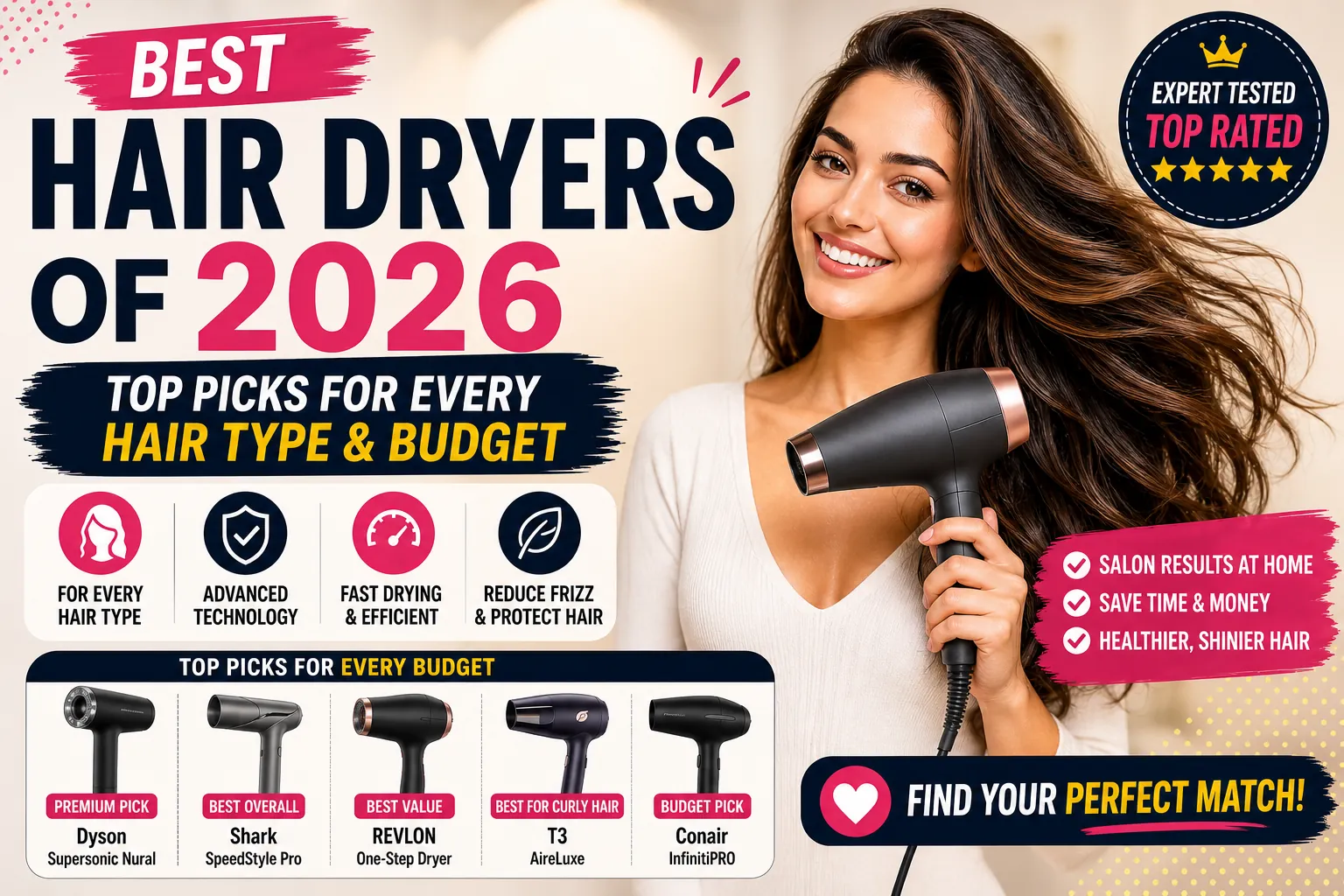
Best Hair Dryers of 2026: Our Top Picks by Category
Here’s a fast-reference guide to our recommended picks across different needs and budgets. Click each to read the full review.
Best Overall — Dyson Supersonic
Intelligent heat control, ultra-quiet high-speed motor, magnetic attachments, proven results. Expensive, but different from everything else on the market.
Best Budget — Revlon One-Step
A 2-in-1 dryer-brush hybrid that delivers blowout-worthy results at a fraction of salon prices.
Best Dyson Alternative — Shark Speedstyle
High-speed motor and magnetic attachments at roughly half the Dyson price. Outstanding for curly and wavy hair.
Best Professional — BaBylissPRO Nano Titanium
Salon-grade power and durability with titanium technology for ultra-fast drying of thick, coarse hair. Built to last.
Best Travel — Conair InfinitiPRO
Dual voltage, foldable handle, great performance for a compact dryer. Most reliable budget travel dryer of 2026.
How to Dry Your Hair Correctly - by Best Hair Dryers
Even the best hair dryer available will not save you if your technique is off. Furthermore, poor technique is the single most common cause of blow-dry damage. Therefore, follow these six steps consistently for healthy results every time:
- Towel blot — don't rub. Rubbing wet hair roughens the cuticle and causes frizz. Pat or squeeze instead.
- Apply heat protectant to damp hair before you start. Non-optional for anyone who cares about hair health.
- Rough dry on low or medium heat until hair is about 70% dry. Point the nozzle downward along the hair shaft.
- Section and style. Work in sections with a round brush and your concentrator nozzle for a smooth finish.
- Finish with the cool shot. Run cold air over each styled section to lock the cuticle and set the shape.
- Keep the dryer moving. Never hold it stationary on one spot for more than a second or two.
Best Hair Dryers - FAQs
The most common questions we get about hair dryers — answered honestly.
Neither is strictly better. Ionic excels at frizz control and speed. Furthermore, ideal for thick or coarse hair. Ceramic provides gentler, more even heat. So, it is better for fine, damaged, or color-treated hair. Many quality dryers in 2026 combine both technologies.
A quality hair dryer should last 3–5 years with regular home use. Therefore, it is signs time to replace: reduced airflow, inconsistent heat, burning smell, or the motor cutting out. Moreover, professional-grade models can last significantly longer.
Not directly. Wattage drives airflow, not temperature alone. A 2000W dryer with intelligent heat control can cause less damage than a basic 1875W model with no regulation. Prioritize heat control features over raw wattage.
For most people, no. A quality 1875W ionic or ceramic dryer in the $50–$120 range serves daily needs well. The premium is worth it if you have thick, textured, or color-treated hair that takes a long time to dry, or if you style daily and want maximum heat protection.
Standard US hair dryers (120V) will not work in Europe (220–240V) without a voltage converter. If you travel internationally, buy a dual-voltage model — look for “100–240V” in the specs.
AC motors are heavier but more powerful and durable — common in professional dryers. DC motors are lighter and quieter but wear out faster. Brushless digital motors (Dyson, Shark, T3) combine quiet operation, high power, and long lifespan.
Which is Best Hair Dryer for You? The Bottom Line
Choosing the right hair dryer in 2026 still comes down to three things: your hair type, your styling habits, and your budget. Furthermore, the good news is that a great result is achievable at almost any price point — provided you match the dryer to your specific needs. Therefore, use the checklist below to make your final decision confidently.
- Fine or damaged hair? Prioritize heat control. Ceramic or intelligent-sensor models are your best option.
- Thick or coarse hair? Go for 1875W+ with ionic or tourmaline technology and strong airflow.
- Curly hair? Make sure a diffuser is included. Look at the Shark Speedstyle or Dyson Supersonic.
- Traveling often? A dual-voltage, foldable travel dryer is a must.
- Budget-conscious? The Revlon One-Step Volumizer remains one of the best-value hair tools ever made.