
Best Coffee Maker for Home Use: Types, Technology and How to Choose (2026)
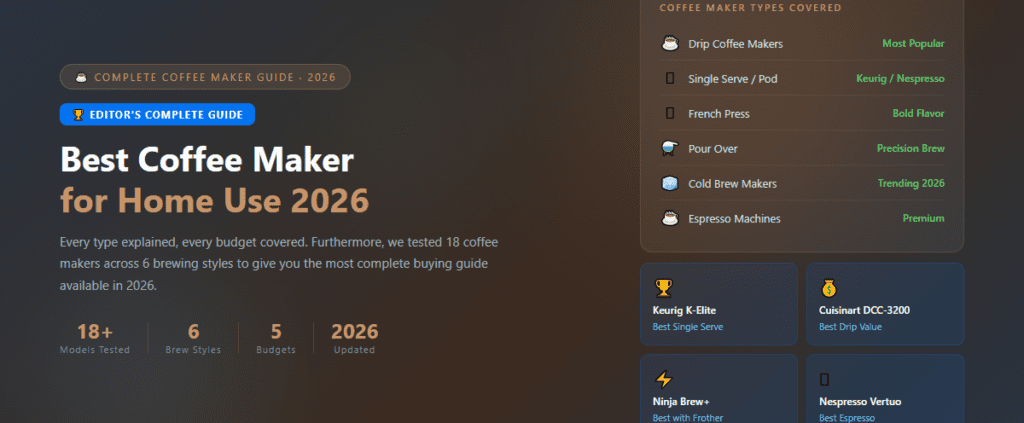
Finding the best coffee maker for home use in 2026 is not as simple as picking the most popular model. Furthermore, the right coffee maker depends entirely on how you drink coffee — how many cups per day, what brew style you prefer, and how much counter space and budget you have available. Consequently, this complete guide covers every type of coffee maker, every key technology, and the exact models worth buying at every price point so you can make the right decision with confidence.
What You Will Find In This Guide
Why Choosing the Best Coffee Maker for Home Use Matters
The average American coffee drinker consumes 3.2 cups per day. Furthermore, over a year that adds up to over 1,100 cups — which means your coffee maker is one of the most-used appliances in your entire home. Consequently, choosing the wrong one does not just mean bad coffee. It means daily frustration, wasted money on pods or grounds that do not suit the machine, and an appliance that ends up sitting unused after three weeks.
The best coffee maker for home use is not necessarily the most expensive one on the shelf. Moreover, it is the one that matches your actual brewing habits — your cup count, your preferred coffee style, your available counter space, and your budget. Additionally, according to the National Coffee Association, home brewing is at an all-time high in 2026 — with 74% of American adults brewing coffee at home daily. Therefore, the market has responded with more options at every price point than ever before.
This guide cuts through all of it. Here is exactly how to choose the best coffee maker for home use in 2026.
How Does a Drip Coffee Maker Work? The Basics Explained
Understanding the basic mechanism helps you appreciate why different machines produce different results — and why the best coffee maker for home use for one person is not the same for another.
Water Reservoir
Cold water sits in a reservoir on the side or back of the machine. Furthermore, the heating element pulls water from the reservoir and heats it to the optimal brewing temperature of 195–205°F.
Heating Element
A nichrome wire heating element heats the water rapidly. Moreover, premium machines use boiler systems that maintain more precise temperature control — consequently producing more consistent extraction and better-tasting coffee.
Brew Basket and Filter
Hot water drips through a shower head over the ground coffee in a filter basket. Furthermore, the filter — paper or reusable mesh — holds the grounds while allowing brewed coffee to pass through into the carafe below.
Carafe
Brewed coffee collects in a carafe — either glass with a hot plate or insulated thermal. Additionally, thermal carafes keep coffee hot for 2 to 4 hours without a hot plate — consequently preserving flavor better than glass carafes on continuous heat.
Types of Coffee Makers Explained: Which Is Best for Home Use?
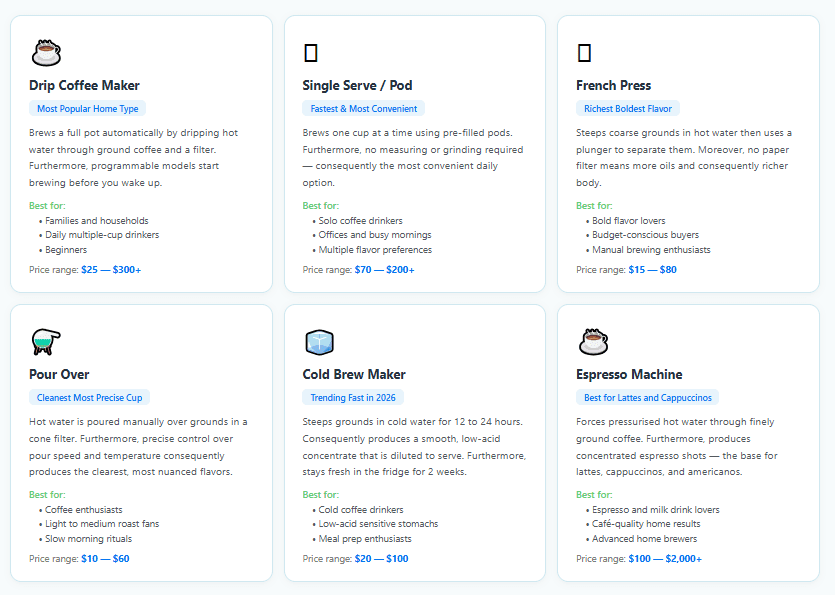
The best coffee maker for home use depends first on brew style. Furthermore, each type produces a distinctly different cup — so knowing which style suits you is the single most important decision before buying.
Want step-by-step brewing instructions for each type? Read our How to Make Coffee at Home Like a Barista guide — complete technique for every brewing method.
Key Coffee Maker Technologies: What the Specs Actually Mean
Here is plain-language explanation of every technology feature you will encounter when shopping for the best coffee maker for home use.
Programmable Timer
Lets you set the coffee maker to begin brewing automatically at a preset time. Furthermore, waking up to already-brewed coffee is the most commonly cited reason buyers choose programmable models. Moreover, most good programmable coffee makers for home use start at around $40 and consequently deliver one of the best quality-of-life upgrades in any kitchen.
Built-In Grinder
Grinds whole beans immediately before brewing — consequently producing significantly fresher, more aromatic coffee than pre-ground. Furthermore, pre-ground coffee loses 60% of its volatile aromatic compounds within 15 minutes of grinding. However, machines with built-in grinders cost more and require additional cleaning steps.
Thermal Carafe vs Glass
A glass carafe sits on a hot plate to keep coffee warm — but heat degrades coffee flavor over 20 to 30 minutes. Furthermore, a thermal insulated carafe keeps coffee hot for 2 to 4 hours without heat. Consequently, for anyone who does not drink a full pot immediately, a thermal carafe is the better choice for taste.
SCA Certification
SCA-certified coffee makers (Specialty Coffee Association) are tested and confirmed to brew at the correct temperature of 197–205°F and with the correct contact time. Furthermore, only around 40 machines globally carry this certification. Consequently, an SCA-certified coffee maker is the most reliable way to ensure consistently high-quality extraction.
Bloom Function
A bloom or pre-infusion function briefly wets the grounds before the full brew cycle begins. Furthermore, this releases CO2 trapped in fresh-roasted coffee — consequently improving flavor extraction significantly. Moreover, premium drip machines include this feature automatically.
Pause and Pour
Pauses brewing temporarily when you remove the carafe mid-cycle — so you can pour a cup without waiting for the full pot. Furthermore, most mid-range and premium coffee makers include this feature. Consequently, it is a practical convenience worth verifying before purchasing any machine.
How to Choose the Best Coffee Maker for Home Use by Household
Solo Drinker (1 cup per day) Best choice: Single serve pod machine or compact French press.
Furthermore, a single serve coffee maker for home use is the most logical choice when you drink one or two cups per day. Brewing a full 12-cup pot and wasting 10 cups every morning is both wasteful and expensive over time.
What to look for:
- Single serve pod machine (Keurig or Nespresso) for maximum convenience
- Compact French press (350ml size) for bold flavor without waste
- 1 to 4 cup drip maker if you prefer hands-off brewing
- Consequently, budget $60 to $150 for a quality single-serve setup
→ Keurig K-Elite Review — our top single-serve pick
Couple (2 to 4 cups per day) Best choice: 4 to 8 cup drip coffee maker or single serve with large reservoir.
For two coffee drinkers, a small to mid-size drip maker is the most efficient best coffee maker for home use. Furthermore, a 4 to 8 cup machine uses less water and energy than a 12-cup machine brewing half-full every day.
What to look for:
- 4 to 8 cup programmable drip maker in the $40 to $80 range
- Thermal carafe model if you drink coffee over 30+ minutes
- Pause and pour feature for staggered morning schedules
- Additionally, single serve machines with a large reservoir work well for couples who prefer different coffee styles
Family (5 to 8 cups per day) Best choice: 12 to 14 cup programmable drip maker with thermal carafe.
A family household needs volume, reliability, and the ability to have coffee ready on a schedule. Furthermore, a 12 to 14 cup programmable drip coffee maker is the correct best coffee maker for home use at family scale.
What to look for:
- 12 to 14 cup capacity programmable machine
- Thermal carafe for maintaining temperature without burning flavor
- Built-in filter reminder or easy-access filter basket for daily use
- Budget $60 to $120 — Cuisinart and Hamilton Beach lead this category
→ Cuisinart DCC-3200 Review — our top family drip pick
Coffee Enthusiast Best choice: SCA-certified drip maker, pour over, or French press.
Coffee enthusiasts prioritise extraction quality over volume and convenience. Furthermore, for this buyer the best coffee maker for home use is one that allows control over temperature, contact time, and grind size.
What to look for:
- SCA-certified drip machine (OXO Brew, Technivorm Moccamaster)
- Built-in grinder for freshest possible extraction
- Pour over setup (Chemex, Hario V60) for manual control
- French press for full-immersion bold flavor
- Consequently, budget $80 to $300+ depending on how deep the obsession goes
Coffee Maker Wattage Guide and Brew Temperature Explained
Wattage in coffee makers determines how quickly the machine heats water and how well it maintains brewing temperature throughout the cycle. Furthermore, unlike hair dryers where higher wattage always means more power, coffee maker wattage has an ideal range — too low and water does not reach optimal temperature, too high and water overheats, scorching the grounds and producing bitter coffee.
Under 800W
Below optimal range — water may not reach 195°F. Furthermore, extraction is consequently weak and the coffee tastes flat or thin. Avoid for primary home use.
800 to 1000W
Acceptable range for compact or budget machines. Furthermore, water reaches adequate temperature but heat-up time is slower. Suitable for 1 to 4 cup machines.
1000 to 1500W
The sweet spot for best coffee maker for home use. Furthermore, this range heats water quickly to the ideal 197–205°F and maintains it consistently throughout brewing. Consequently, the vast majority of quality home drip machines run in this range.
Above 1500W
Found in commercial and prosumer machines. Furthermore, higher wattage allows faster throughput for high-volume use. However, for home use it offers no meaningful benefit over the 1000 to 1500W range.
Optimal Brewing Temperature
The National Coffee Association and SCA both specify that the ideal brewing temperature for drip coffee is 197°F to 205°F (91°C to 96°C). Furthermore, water below 195°F under-extracts coffee — producing a weak, sour cup. Additionally, water above 205°F over-extracts — producing a bitter, harsh taste. Consequently, when evaluating any coffee maker for home use, always check whether the manufacturer specifies brewing temperature compliance.
Best Coffee Maker for Home Use 2026: Our Top Picks
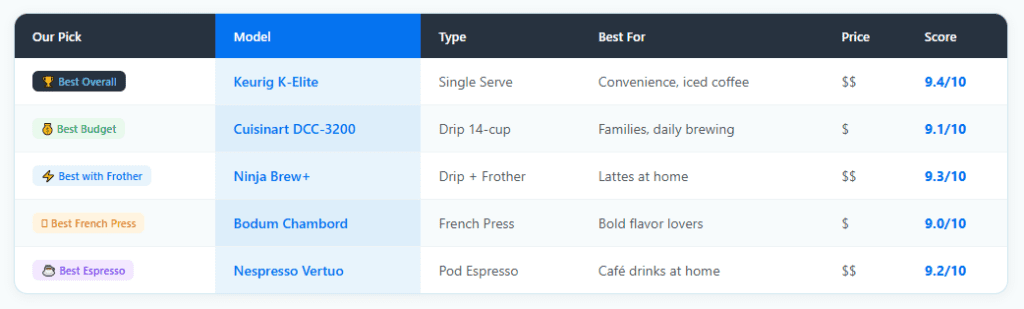
Every pick below earned its place through independent testing. Furthermore, no brand paid for placement in this guide. Consequently, all ratings reflect real performance across our testing period.
Explore Each Pick in Detail
Drip vs Pour Over vs French Press vs Pod: Which Brewing Style Is Best?
The brewing style is the most personal decision in coffee — and consequently the one that matters most when choosing the best coffee maker for home use. Furthermore, each method produces a fundamentally different cup of coffee that is not just about strength but about character and texture.
Drip vs French Press
Drip coffee uses a paper or mesh filter that removes coffee oils — consequently producing a clean, light-bodied cup with clear flavor. Furthermore, French press steeps grounds in direct contact with water and uses no paper filter — meaning all the oils remain in the cup. As a result, French press coffee is significantly richer, heavier, and bolder. Moreover, there is no universally better option — it is entirely a preference for clean versus full-bodied texture. Therefore, try both styles before committing to a machine if you are unsure which you prefer.
Pour Over vs Drip
Pour over produces the cleanest, most nuanced cup of any brewing method — because manual pouring gives precise control over water distribution, contact time, and flow rate. Furthermore, the result highlights subtle flavor notes in light and medium roasts that drip machines obscure. However, pour over requires 4 to 6 minutes of active attention per brew — making it unsuitable for rushed mornings. Additionally, it produces only one to two cups per session. Consequently, pour over is the method of choice for enthusiasts who prioritise flavor quality and enjoy the ritual of manual brewing.
Pod Machine vs Drip Machine
Pod machines brew one cup at a time from a sealed capsule — consequently providing maximum convenience and zero waste per cup. Furthermore, drip machines brew a full pot — meaning the first and last cup of the pot are made from the same batch of grounds. Moreover, pod machines cost more per cup than ground coffee ($0.60 to $1.50 per pod vs $0.10 to $0.30 per drip cup). Therefore, for high-volume households a drip machine is more economical, while solo drinkers benefit more from the convenience of pod machines.
Espresso Machine vs Drip Maker
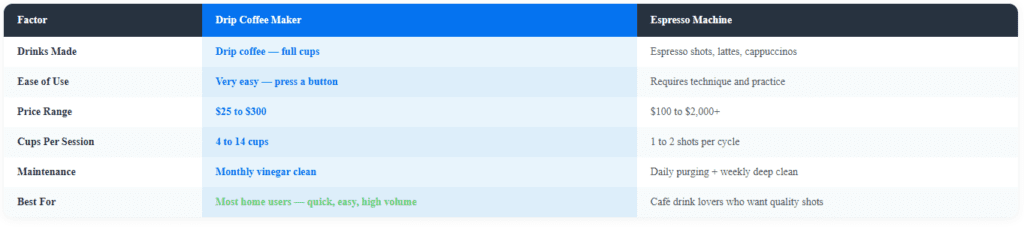
Espresso machines and drip coffee makers produce fundamentally different beverages. Furthermore, espresso is a concentrated 1 to 2 oz shot — not a diluted beverage like drip coffee. Consequently, comparing them directly misses the point. An espresso machine is the correct best coffee maker for home use choice only if you specifically want lattes, cappuccinos, americanos, or other espresso-based drinks. Moreover, entry-level espresso machines start at $100 but require significantly more technique and maintenance than a drip maker. Therefore, choose based on the drinks you actually want — not the machine’s prestige.
Best Coffee Maker for Home Use by Budget
Not sure where to start? Furthermore, here is the simplest budget-matched recommendation for the best coffee maker for home use at every spending level.
Under $30
Go for a simple 12-cup drip maker from Hamilton Beach or a glass French press. Furthermore, at this budget you get basic brewing — no programmable features, no thermal carafe. However, for anyone who just wants hot coffee each morning without fuss, this budget is perfectly adequate.
$30 to $75
The Cuisinart DCC-3200 lives in this range — and it is the best coffee maker for home use under $75 by a significant margin. Furthermore, you get a programmable 14-cup machine with a warming plate, pause and pour, and reliable daily performance. Consequently, this is the sweet spot for most home buyers.
$75 to $150
The foldable handle collapses the dryer to a compact size that fits inside a standard carry-on toiletry bag. Furthermore, a swivel cord base prevents tangling during packing. Additionally, the folded profile takes up significantly less space than any full-size dryer.
$150 to $250
Programmable machines with built-in grinders and SCA-certified brewing temperatures. Furthermore, the OXO Brew 9-Cup is the standout pick here. Consequently, this is the correct budget for serious home brewers who want consistent specialty-grade results.
$250 and Above
Technivorm Moccamaster, Breville Precision Brewer, and similar prosumer drip machines. Furthermore, these are SCA-certified with precise temperature control and high-quality build materials. Consequently, worth every dollar for daily enthusiast drinkers.
→ Want the full comparison at every budget level? Read our Best Coffee Makers 2026 Buying Guide

How to Clean a Coffee Maker With Vinegar: Step by Step
Cleaning your coffee maker is not optional — it is essential for both flavor and machine longevity. Furthermore, mineral deposits from hard water — called limescale — build up inside the machine over time, consequently blocking water flow and reducing brewing temperature below the optimal range. Additionally, coffee oil residue inside the basket and carafe makes every subsequent cup taste stale and bitter.
The good news is that cleaning a coffee maker with vinegar takes under 15 minutes and should be done every 4 to 6 weeks with regular use.
How to Clean a Coffee Maker With Vinegar — Full Steps
- Empty the carafe and remove any used filter and grounds from the basket
- Fill the water reservoir with a solution of half white vinegar and half water
- Place the empty carafe under the brew basket and start a brew cycle
- Halfway through the cycle, pause the machine and let the vinegar solution sit for 30 minutes — this dissolves limescale deposits inside the boiler and tubes
- Resume and complete the brew cycle — discard the vinegar solution from the carafe
- Fill the reservoir with fresh cold water only and run a complete clean water cycle
- Repeat the clean water cycle a second time to fully remove any vinegar taste or smell
- Remove the filter basket and carafe — wash both with warm soapy water, rinse thoroughly, and allow to air dry
💡 PRO TIP: If your coffee maker has a dedicated descale or clean cycle button, use that instead of manual vinegar steps — it optimises the timing automatically. Furthermore, always check your machine’s manual first, as some manufacturers specify descaling solution rather than vinegar to protect internal components.
Coffee Maker vs Espresso Machine: Which Is Right for Your Home?
This is one of the most common questions from first-time buyers — and the answer is simpler than most people expect. Furthermore, the best coffee maker for home use is the one that makes the drinks you actually want to drink every morning, not the one that sounds most impressive.
Frequently Asked Questions — Best Coffee Maker for Home Use
The most common questions buyers ask about choosing a coffee maker for home use — answered from real testing experience.
What is the best coffee maker for home use in 2026?
The best coffee maker for home use depends on your brewing style and household size. Furthermore, for single-serve convenience the Keurig K-Elite is our top pick. For families needing a full pot daily, the Cuisinart DCC-3200 is the best drip coffee maker for home use. Additionally, for specialty drinks and lattes the Ninja Brew+ leads the category. Consequently, the best model for you is the one that matches how you actually drink coffee.
How often should I clean my coffee maker?
Clean your coffee maker every 4 to 6 weeks with a vinegar descaling cycle. Furthermore, wash the filter basket and carafe with warm soapy water after every use. Additionally, if your machine has a descale indicator light, use that as your primary guide. Consequently, regular cleaning prevents limescale buildup that reduces brewing temperature and consequently produces worse-tasting coffee over time.
Is a thermal carafe better than a glass carafe?
For most home users — yes. Furthermore, a glass carafe on a hot plate keeps coffee warm but the continuous heat degrades flavor rapidly after 20 to 30 minutes. A thermal carafe keeps coffee hot for 2 to 4 hours without any external heat. Consequently, the coffee tastes better longer with a thermal carafe. However, glass carafes are cheaper to replace if broken and let you see how much coffee remains.
What wattage coffee maker should I buy for home use?
Look for a machine in the 1000 to 1500W range. Furthermore, this wattage range reliably heats water to the SCA-recommended brewing temperature of 197–205°F. Additionally, machines below 800W may not reach optimal brewing temperature — consequently producing weak, under-extracted coffee regardless of how good your beans are.
How many cups does a coffee maker make per pound of coffee?
One pound of ground coffee makes approximately 40 to 45 standard 8-oz cups of drip coffee. Furthermore, the standard coffee-to-water ratio is 1 to 2 tablespoons of ground coffee per 6 oz of water. Consequently, a 12-cup pot uses roughly 12 tablespoons or 3/4 cup of ground coffee per full brew cycle.
Is it better to buy a coffee maker with a built-in grinder?
ITEM 6 → H3: Is it better to buy a coffee maker with a built-in grinder? For freshness — yes, significantly. Furthermore, ground coffee loses approximately 60% of its aromatic compounds within 15 minutes of grinding. Consequently, a built-in grinder that grinds beans immediately before brewing produces noticeably more aromatic and flavorful coffee. However, machines with grinders cost more and require additional cleaning steps. Therefore, buy one if fresh flavor is your priority and you are willing to clean the grinder weekly.
The Bottom Line: Choosing the Best Coffee Maker for Home Use
Choosing the best coffee maker for home use in 2026 comes down to four questions: How many people drink coffee in your household? What brewing style do you prefer? How much time do you want to spend each morning? And what is your budget? Furthermore, the answer to each of those questions points directly to a specific type of machine — and consequently eliminates the confusion that comes from comparing features across incompatible categories.
Use the type guide and budget guide above to narrow your choice. Moreover, click through to any of the individual reviews below for detailed testing data on each specific model. Therefore, by the time you finish reading, you will have a clear answer rather than more questions.
- Solo drinker: Keurig K-Elite or Nespresso Vertuo — single-serve convenience above all else
- Family household: Cuisinart DCC-3200 — best drip coffee maker for home use under $75
- Latte and specialty drink lover: Ninja Brew+ — built-in frother at a mid-range price
- Bold flavor seeker: French press — richest cup available at the lowest price point
- Furthermore, coffee enthusiast wanting maximum quality: SCA-certified drip or pour over setup
Explore the Full Coffee Maker Guide
Last updated: January 2026. Some links in this guide may be affiliate links. We only recommend products we have independently tested and genuinely believe offer real value.