
How to Make Coffee at Home Like a Barista: Complete Brewing Guide (2026)
Most people who want to make coffee at home like a barista are already doing the hardest part — buying decent beans. Furthermore, the gap between average home coffee and café-quality coffee is almost entirely technique, not equipment. Consequently, whether you use a basic drip machine or a French press, applying the right ratios, temperatures, and brewing steps consistently produces coffee that genuinely rivals what you pay $6 for at a café. This guide covers every method with the exact steps that make the difference.
In This Brewing Guide
Why Home Coffee Tastes Different from Café Coffee
The honest answer is that most home coffee tastes worse than café coffee for three specific and fixable reasons — not because the equipment at home is inferior. Furthermore, understanding these three reasons is the first step toward learning how to make coffee at home like a barista who has simply been trained to avoid them.
The three most common causes of poor home coffee are: incorrect coffee-to-water ratio, water that is either too hot or not hot enough, and stale beans or pre-ground coffee that lost its aromatics days before brewing. Consequently, fixing all three costs nothing and produces an immediate and dramatic improvement in cup quality.
Moreover, according to the Specialty Coffee Association, the most significant variable in home brewing quality is water temperature — not the brand of machine or the price of the beans. Therefore, before buying any new equipment, calibrating your technique is always the higher-value first step.
The Three Mistakes That Make Home Coffee Taste Bad
Fix these first before changing anything else. Furthermore, correcting all three takes under two minutes and costs nothing.
Mistake 1 — Wrong Ratio
Too much water per gram of coffee produces weak, watery, under-extracted coffee. Too little water produces harsh, over-concentrated bitterness. Furthermore, most home users never measure — they scoop loosely by habit. Consequently, the fix is simple: use 1 tablespoon of ground coffee per 6 oz of water as your starting point every single time.
✅ FIX: Use 1 tbsp coffee per 6 oz water (1g coffee : 16g water by weight for precision)
Mistake 2 — Wrong Temperature
Water that is too cold under-extracts the coffee — producing sour, thin flavor. Water that is boiling (212°F) over-extracts — producing harsh bitterness. Furthermore, the ideal brewing temperature is 197°F to 205°F. Consequently, if you boil water in a kettle and pour immediately, it is slightly too hot. Letting it sit for 45 seconds after boiling brings it to the perfect range.
✅ FIX: Use water at 197–205°F. If using a kettle, wait 45 seconds after boiling before pouring.
Mistake 3 — Stale Coffee
Pre-ground coffee loses 60% of its aromatic volatile compounds within 15 minutes of grinding. Furthermore, most supermarket pre-ground coffee was ground weeks or months before purchase. Consequently, no technique or machine compensates for stale coffee — the aromatics are simply gone. Moreover, whole beans sealed in a valve bag stay fresh for weeks.
✅ FIX: Buy whole beans and grind immediately before brewing. Additionally, check the roast date — aim for beans roasted within the last 2 to 4 weeks
Coffee to Water Ratio Guide: How Much Coffee Per Cup?
The coffee to water ratio is the single most impactful variable you control in home brewing. Furthermore, knowing the correct ratio for each brewing method — and adjusting it to your personal strength preference — is the core skill that separates barista-quality home coffee from the average cup. Here is the complete reference chart for every main brewing method.
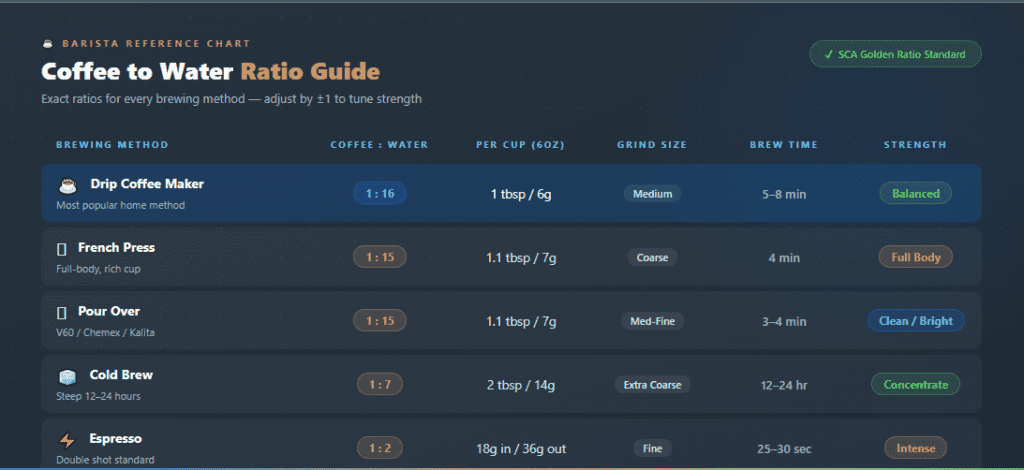
💡 PRO TIP: Always measure by weight (grams) rather than volume (tablespoons) for the most consistent results. Furthermore, a basic kitchen scale costs under $10 and makes it possible to replicate your perfect cup every single time without guessing. Consequently, every professional barista measures by weight — not by scoops.
Ideal Coffee Brewing Temperature: What Every Home Brewer Needs to Know
Temperature is the variable most home brewers never think about — and consequently the one that most commonly explains why home coffee fails to reach café quality. Furthermore, the National Coffee Association and Specialty Coffee Association both specify the same optimal range: 197°F to 205°F (91°C to 96°C).

How to Use a Drip Coffee Maker Like a Pro — Step by Step
A drip coffee maker is the most popular way to make coffee at home like a barista for everyday volume brewing. Furthermore, most people underestimate how much technique affects drip coffee quality — it is not just press a button and walk away. Consequently, applying these specific steps produces noticeably better coffee from the exact same machine and beans.
Step-by-Step Drip Coffee Method
Below optimal range — water may not reach 195°F. Furthermore, extraction is consequently weak and the coffee tastes flat or thin. Avoid for primary home use.
- Start with freshly ground coffee — grind immediately before brewing for best results
- Use a medium grind — similar to sea salt texture — coarser grinds under-extract, finer grinds over-extract
- Measure: 1 tablespoon per 6 oz water (or 60g per 1 litre for precision)
- Use filtered water if possible — tap water minerals affect both flavor and machine longevity
- Fill the reservoir with cold water — never use hot tap water which affects extraction temperature
- If your machine has a bloom or pre-infusion setting, enable it — it releases CO2 and improves extraction
- Press brew and do not lift the carafe mid-cycle unless your machine has pause-and-pour
- Serve immediately or pour into a preheated thermal flask — never leave on a hot plate for more than 20 minutes
How to Make Strong Coffee at Home with a Drip Maker
To make strong coffee at home without bitterness, increase the coffee dose rather than the brew time. Furthermore, adding more grounds to the same water volume increases strength and body without the harsh bitterness that comes from over-brewing. Consequently, try a 1:14 ratio (1g coffee per 14g water) instead of the standard 1:16 — and adjust from there based on your preference.
Looking for the best drip coffee maker for home use? → Cuisinart DCC-3200 Review
How to Make French Press Coffee Step by Step — Barista Method
French Press Step-by-Step Method
- Preheat the French press by filling with hot water, swirling, and discarding — prevents temperature drop on contact
- Measure 60g coarse-ground coffee per 900ml water (1:15 ratio) — grind should feel like coarse sea salt
- Add ground coffee to the empty preheated press
- Start a 4-minute timer and pour hot water (200°F — 45 seconds off the boil) over the grounds
- Pour about 100ml first and wait 30 seconds — this is the bloom stage that releases CO2 for better extraction
- Pour the remaining water steadily and place the lid on top with the plunger pulled fully up — do not press yet
- At 4 minutes, press the plunger down slowly and firmly — pressing too fast causes over-extraction and bitterness
- Pour immediately — do not leave brewed coffee sitting in the press as it continues extracting and becomes bitter
Why Does French Press Coffee Taste Bitter?
French press coffee becomes bitter for two main reasons: grinding too fine or leaving coffee in the press after brewing. Furthermore, a fine grind passes through the metal filter, over-extracts during steeping, and results in harsh bitterness. Consequently, always use a coarse grind and pour immediately after pressing for the cleanest, richest result.
Looking for the best French press? → Best French Press Coffee Maker Review 2026
How to Make Cold Brew Coffee at Home — The Easiest Method
Cold brew is the fastest-growing coffee segment in 2026 — and it is also one of the easiest ways to make coffee at home like a barista. Furthermore, unlike every other brewing method that requires precise temperature control and timing, cold brew is genuinely hard to mess up. Consequently, it is an excellent starting point for anyone new to barista-style home coffee.
Cold Brew Step-by-Step Method
- Use a coarse grind — finer grinds produce muddy, over-bitter cold brew
- Combine 100g ground coffee with 800ml cold or room-temperature filtered water in a large jar or jug (1:8 ratio for concentrate)
- Stir gently to ensure all grounds are saturated — there should be no dry pockets of coffee
- Cover and place in the refrigerator — cold brewing slows extraction and produces a smooth, less acidic result
- Steep for 12 to 24 hours — 12 hours produces a lighter result, 24 hours a fuller stronger concentrate
- Strain through a paper coffee filter, cheesecloth, or a dedicated cold brew filter into a clean jar
- Dilute the concentrate before serving — typically 1 part cold brew to 1 part water or milk
- Store in the fridge for up to 2 weeks — cold brew concentrate keeps far longer than brewed hot coffee
Cold Brew vs Iced Coffee — What Is the Difference?
Iced coffee is simply hot-brewed coffee poured over ice — consequently it is more acidic, more bitter, and more diluted than cold brew. Furthermore, cold brew is brewed entirely with cold water over a long period — consequently extracting fewer bitter acids and more sweet, chocolatey compounds. As a result, cold brew tastes smoother and naturally sweeter without any added sugar. Therefore, if you find hot coffee too acidic or bitter, cold brew is likely the style that will change your mind.
Why Does My Coffee Taste Bitter? — Every Cause and Fix
Bitter coffee is the most common complaint from home brewers — and furthermore it is almost always caused by one of six specific fixable issues rather than the beans themselves. Consequently, before blaming your coffee or your machine, work through this checklist. Style: 17px | Color #54595F | Line height 1.85 | Margin bottom 30px
Causes and Fixes
- Grind too fine — over-extracts bitter compounds. Fix: Use a coarser grind setting
- Water too hot (above 205°F) — scorches grounds. Fix: Let boiled water cool 45 seconds before brewing
- Coffee brewed too long — left on hot plate over 20 minutes. Fix: Pour into thermal carafe immediately
- Too much coffee per unit of water — over-concentrates bitter acids. Fix: Reduce coffee dose slightly
- Old or rancid beans — oils go stale and turn bitter. Fix: Buy fresh-roasted beans within 4 weeks of roast date
- Dirty coffee maker — rancid oil residue coats the basket. Fix: Clean basket with soapy water daily
How to Make Coffee Taste Better
- Buy whole beans roasted within the last 2 to 4 weeks — freshness is the biggest quality factor
- Grind immediately before brewing — pre-ground coffee is always stale compared to freshly ground
- Use filtered water — hard tap water adds mineral off-flavors that compete with coffee's natural sweetness
- Measure your coffee and water every time — consistency is the foundation of great home coffee
- Furthermore, add a pinch of salt to the grounds before brewing — it neutralises bitterness without adding saltiness
- Store beans in an airtight opaque container at room temperature — not in the fridge or freezer
How to Store Coffee Beans at Home to Stay Fresh Longer
Freshness is the variable that separates a coffee that tastes complex and aromatic from one that tastes flat and stale — and furthermore it is entirely within your control regardless of what machine you use. Coffee beans are degraded by four enemies: air, moisture, light, and heat. Consequently, correct storage removes all four threats simultaneously.
✅ DO
- Store in an airtight container with a one-way CO2 valve — allows gases out without letting air in
- Keep at room temperature in a dark cupboard away from the oven or direct sunlight
- Buy smaller quantities more frequently — 250g to 500g at a time if you brew daily
- Furthermore, check the roast date before buying — aim for beans roasted within the last 2 to 4 weeks
- Grind only what you need immediately before each brew session
❌ DO NOT
- Do not store in the fridge — moisture and fridge odors penetrate beans and degrade flavor
- Do not store in the freezer unless buying in bulk — repeated freeze-thaw cycles damage the cell structure
- Do not keep in the original bag unsealed — paper coffee bags are not airtight once opened
- Do not store near heat sources — the oven, dishwasher, or sunny windowsill all accelerate staling
- Do not pre-grind and store — consequently you lose 60% of aromatics within 15 minutes of grinding
How to Descale a Coffee Maker — Complete Step-by-Step Guide
Descaling removes limescale mineral deposits that build up inside your coffee maker over time — and consequently it is the single most important maintenance task for keeping your machine brewing at optimal temperature. Furthermore, limescale builds up most rapidly in hard water areas and reduces brewing temperature below the SCA minimum of 195°F — making every cup progressively weaker and flatter over time.
Descaling with White Vinegar — Full Method
- Empty the carafe and remove any used filter and grounds from the basket completely
- Fill the water reservoir with equal parts white vinegar and cold water (50/50 mix)
- Place the empty carafe in position and start a normal brew cycle
- After halfway through, pause the machine and allow the vinegar solution to sit for 30 minutes — this dissolves limescale inside the boiler and internal tubes
- Resume and complete the full brew cycle — then discard the vinegar solution
- Fill the reservoir with fresh cold water only and run a complete clean rinse cycle
- Repeat the fresh water rinse cycle a second time to eliminate any residual vinegar taste
- Remove the filter basket and carafe — hand-wash both with warm soapy water, rinse, and air dry
💡 How often: Descale every 4 to 6 weeks with regular use. Furthermore, if you live in a hard water area, increase to every 3 to 4 weeks. Additionally, if your machine has a descale indicator light, that is your primary signal — trust it.
Frequently Asked Questions — How to Make Coffee at Home Like a Barista
The most common questions home brewers ask — answered directly from brewing experience.
How to Make Coffee at Home Like a Barista
How much coffee do I use per cup for drip coffee?
Use 1 tablespoon of ground coffee per 6 oz of water as your starting point. Furthermore, for precision use the weight ratio of 1g coffee per 16g water — this is the SCA golden ratio. Consequently, for a standard 12-cup pot using 60 fl oz of water, you need approximately 10 tablespoons or 60g of ground coffee.
What is the best water temperature for brewing coffee at home?
The ideal temperature is 197°F to 205°F (91°C to 96°C). Furthermore, if using a kettle, let boiled water rest for 45 seconds before pouring to drop from 212°F to approximately 200°F. Consequently, this single adjustment eliminates most of the over-extraction bitterness that home brewers attribute to bad beans.
Why does my home coffee taste weak and watery?
Weak coffee is caused by insufficient coffee per unit of water. Furthermore, it can also result from water temperature below 195°F — under-extraction produces a thin, flat cup even when the ratio is correct. Consequently, check both your coffee-to-water ratio and your brewing temperature before adjusting anything else.
How long does brewed coffee stay fresh?
Brewed coffee tastes best within 20 to 30 minutes of brewing. Furthermore, coffee left on a hot plate deteriorates rapidly — the continuous heat causes oxidation that produces stale, bitter flavors within an hour. Consequently, pour brewed coffee immediately into a preheated thermal carafe for maximum freshness over 2 to 4 hours.
Is it worth grinding coffee beans at home?
Yes — significantly. Furthermore, pre-ground coffee loses approximately 60% of its volatile aromatic compounds within 15 minutes of grinding. Consequently, even a basic $25 hand grinder produces noticeably more aromatic coffee than any pre-ground alternative at the same price. Therefore, grinding fresh is the single highest-value upgrade any home brewer can make.
How do I make coffee less acidic at home?
Switch to cold brew — the cold water extraction process produces significantly lower acid levels than any hot brewing method. Furthermore, choosing a darker roast reduces acidity compared to light or medium roasts. Additionally, adding a small pinch of baking soda (1/4 teaspoon per pot) neutralises some of the acid without affecting flavor.
The Bottom Line: How to Make Coffee at Home Like a Barista
Making coffee at home like a barista does not require expensive equipment — it requires consistent application of three fundamentals: the correct coffee-to-water ratio, the correct brewing temperature, and fresh beans ground immediately before brewing. Furthermore, apply all three consistently and the result is café-quality coffee from whatever machine you already own. Consequently, upgrade your technique before upgrading your equipment — the technique change costs nothing and delivers immediate results.
- Use 1g coffee per 16g water as your starting ratio — adjust by taste from there
- Brew at 197–205°F — wait 45 seconds after boiling if using a kettle
- Grind beans immediately before brewing — freshness is the biggest quality variable
- Use filtered water — hard tap water adds mineral off-flavors that compete with coffee
- Furthermore, clean your machine monthly with a vinegar descale cycle for consistent brewing temperature
Related Coffee Guides
Last updated: January 2026. Some links in this guide may be affiliate links. We only recommend products we have independently tested and genuinely believe offer real value.