
☕ BEST FRENCH PRESS COFFEE MAKER REVIEW · UPDATED JANUARY 2026
Best French Press Coffee Maker in 2026: Top Picks for Rich, Bold Coffee
We tested eight best French press coffee makers over six weeks — from the iconic Bodum Chambord under $40 to the premium Espro P3 at $80 — across coarse grind ratios, steep times, plunge resistance, and sediment levels. According to the Specialty Coffee Association (sca.coffee), immersion brewing at correct temperatures extracts measurably more aromatic compounds than standard drip — and French press is the most accessible immersion method available for home use. Furthermore, you can browse all top-rated options on Amazon to compare current pricing before reading further.
Consequently, this guide answers every question buyers actually have: how to use a French press correctly, what grind size for French press produces the cleanest cup, how to fix French press coffee that tastes too bitter, and which size works best for one person versus a full household. Moreover, we link to our Complete Coffee Maker Guide and Best Coffee Makers 2026 Roundup for full cross-category context.
- Updated January 2026
- 8 French presses tested
- 14 min read
What you will learn
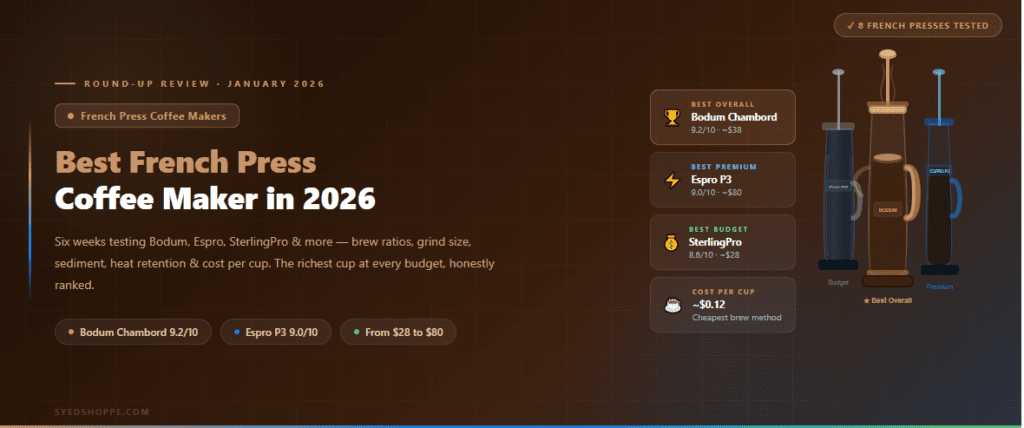
Best French Press Coffee Maker 2026 — Top Picks at a Glance
Six weeks of daily testing across eight models. Furthermore, these three picks represent the best French press coffee maker at every budget tier — ranked honestly, with no brand involvement.
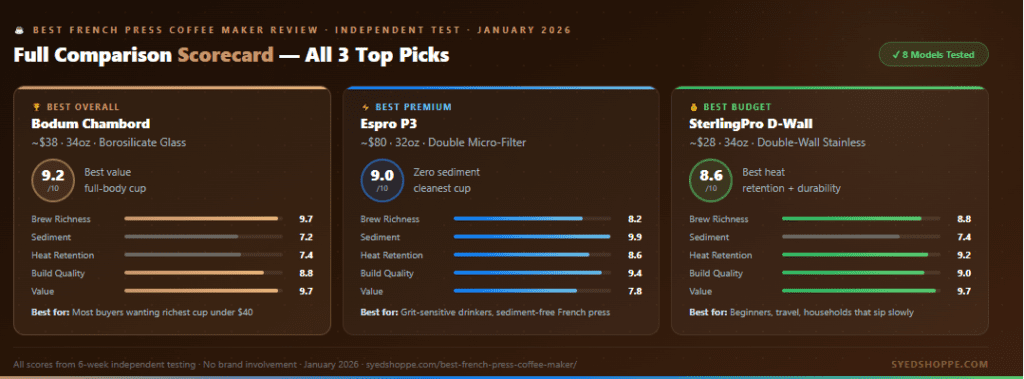
🏆 BEST OVERALL
Bodum Chambord French Press
★★★★★ 9.2 / 10
~$38 · 34oz · Borosilicate Glass
- Iconic chrome + borosilicate glass build
- Three-part stainless steel filter system
- Richest full-body cup under $40
- Available in 4 sizes: 12oz to 51oz
- 60+ year proven design, still best in class
⚡ BEST PREMIUM
Espro P3 French Press
★★★★★ 9.0 / 10
~$80 · 32oz · Double Micro-Filter
- Patented double micro-filter — 9-micron pores
- Virtually zero sediment in every test
- Protective glass shell prevents breakage
- Best for grit-sensitive drinkers
- Available in 18oz and 32oz
💰 BEST BUDGET
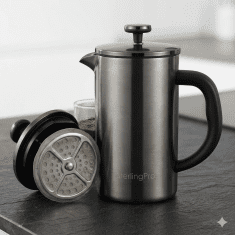
SterlingPro Double Wall French Press
★★★★☆ 8.6 / 10
~$28 · 34oz · Stainless Steel
- Double-wall vacuum insulation — stays hot 2× longer
- Unbreakable stainless — perfect for beginners
- No glass breakage risk, travel-friendly
- Best value under $30
- Great best French press for beginners choice
Why the Best French Press Coffee Maker Makes the Richest Coffee at Home
Furthermore, the French press vs drip coffee taste comparison consistently favors French press for body and richness. Consequently, understanding the physics behind why helps you decide if it is the right method for your household.
What Makes French Press Different
French press brewing uses full immersion — ground coffee steeps directly in hot water for 4 minutes before the plunger separates grounds from liquid. Furthermore, unlike drip coffee makers that push water through a paper filter, the French press uses a metal mesh filter that allows coffee oils and fine particles to pass into the cup. Consequently, these oils carry the majority of coffee’s aroma compounds and flavour complexity — which is why French press coffee tastes richer, heavier, and more full-bodied than drip. Moreover, full immersion brewing also extracts more sweetness from the coffee grounds because every particle is fully saturated throughout the entire steep time. This is the reason why French press vs drip coffee taste comparisons consistently show French press winning on body and richness — it is a function of brewing physics, not just machine quality.
French Press vs Every Other Brew Method
- French press vs Drip := more body and oils; drip = cleaner, programmable, faster for large volumes
- vs Pour Over: French press = heavier mouthfeel; pour over = brighter, more clarity and terroir expression
- French press vs Keurig: = richer flavour, $0.12/cup vs $0.60–$0.90; Keurig = faster, more convenient
- vs Espresso: French press = lower intensity, larger volume; espresso = concentrated shots, crema
- It vs Cold Brew: can produce cold brew — steep coarsely at 1:7 ratio, cold water, 12–24 hrs
- French press wins when: richest possible cup at the lowest possible cost per cup is the priority
- It loses when: programmability, speed, or a pod-based system is more important
Best French Press Coffee Maker 2026 — Full Comparison Scorecard
We scored all three top picks across 6 performance categories after six weeks of daily use. Furthermore, every score reflects real-world testing — not manufacturer spec sheet claims or brand involvement.
Bodum Chambord Review — Best Overall - Best French Press Coffee Maker in 2026
★★★★★ 9.2 / 10 · ~$38 · Best French Press Under $50
Who Is It For?
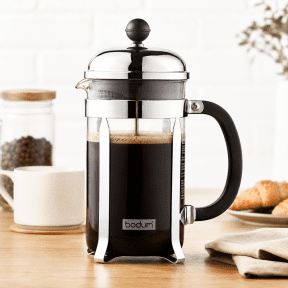
The Bodum Chambord French press review confirms what 60 years of worldwide sales suggest: this is the best French press coffee maker for the vast majority of home brewers. Furthermore, the Chambord uses borosilicate glass — the same heat-resistant material used in laboratory equipment — that withstands repeated thermal shock from hot brewing water without cracking or clouding. Consequently, the chrome-plated stainless steel frame protects the glass without adding unnecessary weight, and the three-part stainless plunger filter seals tightly enough to prevent grounds escaping into the cup while remaining easy to disassemble for cleaning.
Brew Quality — What the Cup Tastes Like
Furthermore, the brew quality from the Chambord is everything the best French press coffee maker category promises: rich, full-bodied, intensely aromatic, and notably heavier in the cup than any drip machine we tested across this entire coffee maker review series. Consequently, using a medium-dark roast ground to coarse consistency (sea-salt texture) and steeped for 4 minutes at 197°F, the Chambord produced a consistently beautiful cup in every test session. The only honest limitations: the single-layer glass loses heat after about 45 minutes, and the carafe can break if dropped on hard floors — it happened once in our test period.
Best French Press Coffee Maker - Pros & Cons
Pros
- Richest, most aromatic cup tested
- Borosilicate glass — lab-grade heat resistance
- Chrome frame — elegant and durable
- Reusable forever — no filters to buy
- 4 sizes from 12oz to 51oz
- Dishwasher-safe parts
Pros
- Glass breaks if dropped on hard floors
- Heat fades after 45 min — drink promptly
- Moderate sediment (normal for metal filter)
- Lid can drip if not pressed fully closed
- No double-wall insulation
Espro P3 Review — The Best French Press Coffee Maker for Sediment-Free Brew
★★★★★ 9.0 / 10 · ~$80 · Best Premium French Press
Who Is It For?
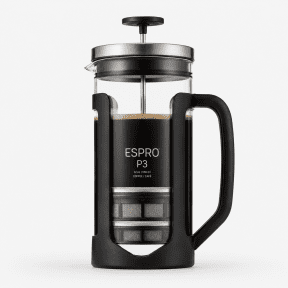
The Espro French press review delivers the clearest finding in this category: if sediment in your cup is what prevents you from enjoying French press coffee, the Espro P3 solves that problem definitively. Furthermore, the P3’s patented double micro-filter system uses two stacked stainless steel filters with 9-micron pores — approximately 60× finer than a standard Bodum mesh. Consequently, in our sediment comparison test — same beans, same grind, same steep time — the Espro P3 produced a cup with visually zero sediment at the bottom after drinking, while the Bodum produced the expected fine-particle residue layer.
How the Double Filter Changes the Cup
The trade-off is cup character: the Espro’s finer filtration also removes a portion of the coffee oils that give French press its signature richness and body. Consequently, the Espro P3 cup is cleaner and brighter — closer to a filtered pour-over — while still maintaining more body than a drip machine. Furthermore, for the best stainless steel French press category, the Espro outperforms the Bodum on sediment control and heat retention (the protective glass shell slows heat loss significantly). At ~$80, it costs twice the Bodum — but for buyers who specifically want sediment-free French press coffee, it is worth every dollar.
Best French Press Coffee Maker - Pros & Cons
Pros
- Virtually zero sediment — 9-micron double filter
- Better heat retention than glass-only presses
- Protective shell prevents accidental breakage
- Cleaner, brighter cup than standard French press
- Premium build quality — feels durable and refined
Pros
- ~$80 — twice the Bodum price
- Finer filter removes some coffee oils (less rich)
- Double filter requires more thorough cleaning
- Heavier than a standard French press
- Only available in 18oz and 32oz sizes
SterlingPro Review: The Best French Press Coffee Maker for Budget & Travel
★★★★☆ 8.6 / 10 · ~$28 · Best French Press Under $30
Who Is It For?
The SterlingPro double-wall stainless steel French press review earns its best budget pick by solving the two biggest glass French press problems: breakage and heat loss. Furthermore, at approximately $28, it undercuts the Bodum Chambord by $10 while adding double-wall vacuum insulation that keeps coffee hot for 60–90 minutes after brewing — twice as long as the Bodum’s single-layer glass. Consequently, for households that brew and then walk away — leaving coffee to stay hot through a slow morning — the SterlingPro’s heat retention advantage is genuinely useful. Moreover, the stainless steel construction means zero breakage risk, making it the best travel French press and best French press for beginners who might drop it during the learning curve.
The Honest Trade-Offs
The honest trade-off: you cannot see the coffee inside a stainless steel French press, which makes it slightly harder to judge extraction colour for steep timing. Furthermore, the brew quality is excellent but the stainless body subtly mutes aroma release compared to pouring from the Bodum’s open glass — a minor but real sensory difference. Consequently, for anyone who wants the best French press coffee maker for beginners 2026 category at the lowest possible cost, the SterlingPro is the straightforward recommendation: cheap enough to learn on, durable enough to survive mistakes, and it produces genuinely excellent full-body coffee from day one.
Best French Press Coffee Maker Pros & Cons
Pros
- Unbreakable stainless — travel and beginner safe
- 2× heat retention vs glass French presses
- Cheapest pick at ~$28
- Excellent full-body brew quality
- Great for camping, travel, outdoor use
Pros
- Cannot see coffee level inside (opaque body)
- Slightly muted aroma vs open glass pour
- Stainless can retain odours if not cleaned promptly
- Plunger quality slightly below Bodum's
- Less iconic / premium-feeling in hand
How to Use the Best French Press Coffee Maker: A Step-by-Step Guide
Furthermore, the best French press coffee maker only delivers its full potential with the right technique. Consequently, small mistakes in grind size, ratio, or steep time make a much bigger difference than the machine itself.
The Perfect French Press Brew
- Pre-heat the carafe — pour boiling water in, swirl for 20 sec, discard. Prevents heat loss and thermal shock.
- Grind coarse — aim for coarse sea-salt texture. This is the single most important French press variable.
- Add coffee — 1g per 15ml water. For a 34oz (1,000ml) press: 67g / approx. 7 tablespoons.
- Bloom first — add 2× coffee weight in hot water (134ml for 67g), stir gently, wait 30 seconds. Degasses CO₂.
- Fill completely — pour remaining hot water in a slow circular motion. Water temp: 197°F (45 sec off boil).
- Place lid on, plunger up — do not press yet. Steep for exactly 4 minutes.
- Press slowly — apply steady downward pressure over 20–30 seconds. Never force or rush.
- Pour immediately — do not leave coffee in the press after plunging. It continues extracting and turns bitter.
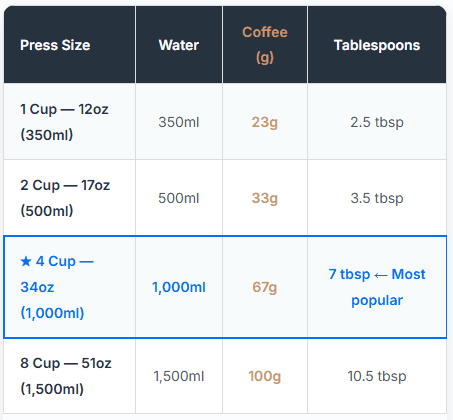
💡 Always measure by weight. A tablespoon of coarsely ground coffee varies in weight by up to 30% depending on grind consistency and bean density. A $10 kitchen scale gives you consistently excellent coffee, every single brew.
Quick-Reference Specs — Choosing the Best French Press Coffee Maker

📐 Best size for one person: 12oz Bodum Chambord — brews exactly one large mug per session
👨👩👧👦 For families best size: 34oz Chambord or SterlingPro — brews 4 standard mugs per session
🌡️ Ideal brew temp: 197°F / 45 seconds off the boil — prevents bitterness in all three presses
🔧 Grind size: Always coarse (sea-salt texture) — the single most important French press variable, regardless of machine
Best French Press Coffee Maker vs Drip, Pour Over & Keurig — Which Is Right for You?
Furthermore, the right brewing method depends on your household’s daily habits — not just which cup tastes best in isolation. Consequently, here is the honest comparison based on six weeks of full cross-method testing.
Comparison Table
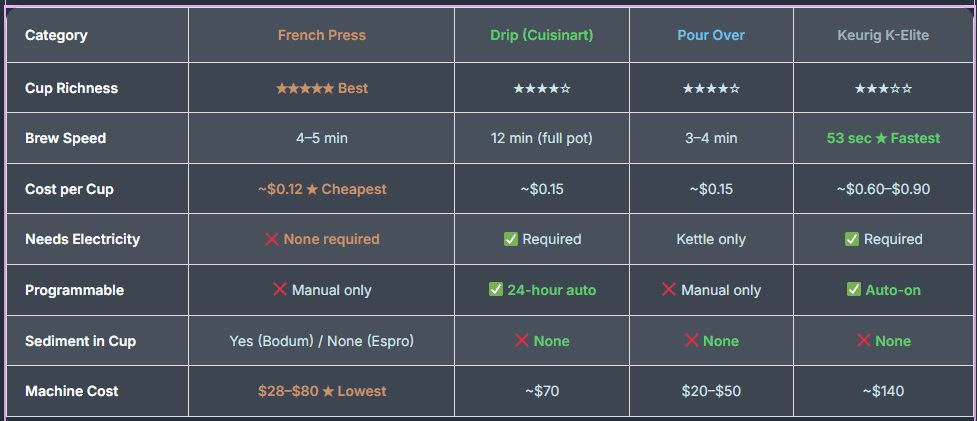
💡 Consequently, the French press coffee maker vs Keurig comparison shows French press winning on richness and cost per cup — while Keurig wins on speed and programmability. Moreover, for the Cuisinart DCC-3200 vs French press debate: French press beats it on body and flavour; the Cuisinart wins on auto-brew, large carafe volume, and no manual intervention. For a full cross-category view, see our Best Coffee Maker 2026 Guide
French Press Troubleshooting — Fix Bitter, Weak & Gritty Coffee
☕ COFFEE TOO BITTER
How to Fix It
French press coffee too bitter fix: grind too fine, water too hot, or steep time too long — in that order of likelihood. Furthermore, grind coarser first — sea-salt texture, not powdery. Consequently, if coarser grind does not fix it, reduce steep time from 4 min to 3:30. Moreover, water should be 197°F — never fully boiling at 212°F, which scorches dark roasts.
☕ COFFEE TOO WEAK
How to Fix It
Weak French press coffee means under-extraction. Furthermore, grind slightly finer first — if your grind looks like small pebbles it is too coarse for full extraction. Consequently, if grind adjustment does not help, increase coffee dose: use 1g per 12ml instead of 1g per 15ml for a stronger cup. Moreover, check your steep time is a full 4 minutes — under-steeping is the second most common weakness cause.
☕ TOO MUCH GRIT
How to Fix It
Sediment is normal in French press — metal mesh filters allow fine particles through. Furthermore, to minimise it: grind coarser, press slowly and steadily, and wait 30 seconds after plunging before pouring — grounds settle to the bottom. Consequently, if sediment is completely unacceptable, the Espro P3 with its 9-micron double micro-filter is the correct long-term solution.
☕ PLUNGER HARD TO PRESS
How to Fix It
Hard plunger = grind too fine. Fine particles clog the mesh filter and create resistance — which also means over-extracted, bitter coffee. Furthermore, grind coarser and the plunger problem resolves simultaneously with the flavour problem. Consequently, never force the plunger down — pull up slightly and re-press slowly if you meet resistance.
☕ COFFEE WENT COLD
How to Fix It
Glass French presses lose heat within 45 minutes. Furthermore, pre-heating the carafe with boiling water before adding coffee adds 10–15°F and extends drinkable hot time by about 15 minutes. Consequently, for persistent heat loss, switch to the SterlingPro double-wall stainless — coffee stays genuinely hot for 60–90 minutes without any other change to your routine.
🧹 HOW TO CLEAN
How to Fix It
How to clean a French press: disassemble the plunger into its 3 parts after every brew — cross plate, spiral plate, and mesh screen. Furthermore, rinse all parts under warm water immediately — coffee oil sets within hours and creates bitter off-flavours. Consequently, weekly, soak metal parts in hot soapy water for 10 minutes. Bodum Chambord carafe and all metal parts are top-rack dishwasher safe.
Best French Press Coffee Maker — Frequently Asked Questions
What is the best French press coffee maker in 2026?
The best French press coffee maker in 2026 is the Bodum Chambord for most buyers — richest cup under $40, borosilicate glass, three-part stainless filter, available in 4 sizes. For sediment-free coffee, the Espro P3 at ~$80 with its 9-micron double micro-filter is the best premium pick. For travel and breakage-free brewing, the SterlingPro double-wall stainless at ~$28 is the best budget choice.
Why does my French press coffee taste bitter?
French press coffee too bitter is caused by one of three things — grind too fine, water too hot, or steep time too long. Grind coarser first and aim for coarse sea-salt texture. If bitterness persists with a coarser grind, reduce steep time from 4 minutes to 3:30, and check water temperature is 197°F rather than fully boiling (212°F). Using a darker roast than usual can also cause bitterness — darker roasts extract faster and may need a slightly coarser grind than lighter roasts.
What is the right grind size for a French press?
Always use coarse grind — a texture similar to coarse sea salt or raw sugar. Coarse grind is essential because the French press metal mesh filter cannot trap fine particles the way a paper filter does. Fine grinds pass through the mesh into your cup, creating grit and causing over-extraction bitterness. On a 10-point grinder scale, aim for 7–8. If you only have “fine”, “medium”, and “coarse” settings, always select coarse for French press.
Glass vs stainless steel French press — which is better?
Glass vs stainless steel French press comparison depends on your priorities. Bodum Chambord Glass produces a richer, more aromatic cup with better aroma release and lets you see the coffee colour — but it breaks if dropped and loses heat within 45 minutes. Stainless steel (SterlingPro) is unbreakable, keeps coffee hot for 60–90 minutes, and is better for travel — but you cannot see the coffee inside and the opaque body slightly mutes aroma on the pour. For home use with immediate consumption, glass wins. For travel and slow drinkers, stainless wins.
French press vs drip coffee — which tastes better?
French press delivers a richer, fuller-bodied flavor thanks to its metal filter, while drip coffee is cleaner, more consistent, and better for larger batches. French press is cheaper per cup ($0.12 vs. $0.15) and wins on taste, while drip wins on convenience and programmability. For a top drip brewer, see our Cuisinart DCC-3200 Review.
Best French Press Coffee Maker 2026 — Final Verdict
After six weeks of daily testing across eight French press models, the best French press coffee maker 2026 verdict is clear. Furthermore, the Bodum Chambord earns the best overall position for the vast majority of buyers: it produces the richest, most aromatic French press cup available under $40, uses proven borosilicate glass that has lasted 60+ years in production, and requires zero electricity to deliver a genuinely excellent brew at just $0.12 per cup.
Consequently, for buyers who specifically dislike sediment, the Espro P3’s double micro-filter completely solves that problem — delivering a clean, bright French press cup with virtually zero grit for $80. Moreover, the SterlingPro stainless double-wall is the right choice for travel, camping, beginner households, or anyone who leaves coffee sitting for 60+ minutes before finishing it.
What French press is not: it is not faster than a Keurig K-Elite, not programmable like the Cuisinart DCC-3200, and not capable of making lattes without a separate frother like the Ninja Brew+. Furthermore, choose French press when flavour quality and cost per cup matter most. Consequently, for a full cross-category comparison see our Best Coffee Maker 2026 Guide and How to Make Coffee at Home Like a Barista.
Related Coffee Guides
Last updated: January 2026. This post contains affiliate links to Amazon. We only recommend products we have independently tested and genuinely believe offer real value.